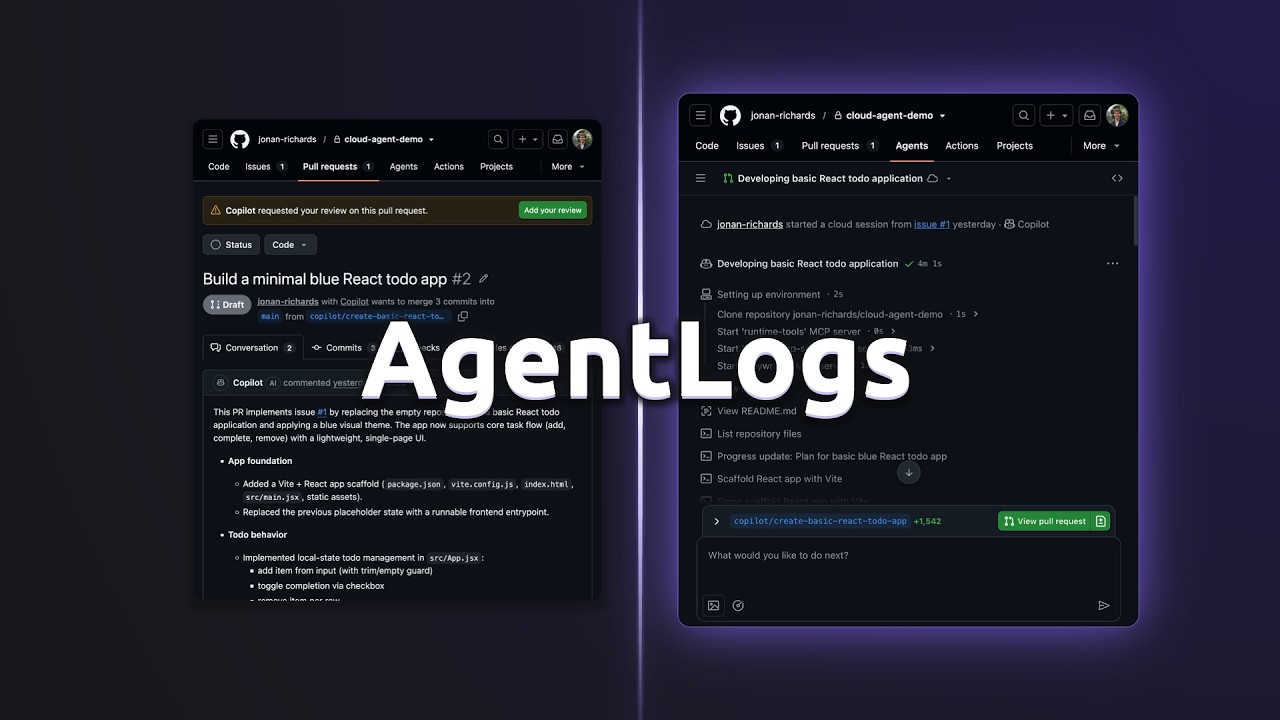
AgentLogs
A large-scale dataset of real-world AI coding agent activity on GitHub. It shows how agents work, not just the pull requests they produce.
- Repositories
- 40.6K
- public, on GitHub
- Tasks
- 364K
- pieces of work handed to an agent
- Sessions
- 636K
- agent runs, one per request
- Pull requests
- 318K
- worked on by agents
- Tool calls
- 28.5M
- file edits, commands, GitHub actions
- Log entries
- 75.6M
- prompts, reasoning, tool calls, results
Why AgentLogs
A pull request shows what a coding agent delivered. It leaves out how the agent got there: the files it read, the commands it ran, the tests that failed, and the follow-ups a developer had to ask for. AgentLogs records all of it, for real work on public GitHub repositories, from the first prompt to the merged or abandoned pull request.
Every step
Prompts, reasoning, each tool call with its arguments and result, and token usage.
Linked outcomes
Each session connects to its pull request, review timeline, and workflow run.
Failures included
Runs that error out or never get merged stay in the data.
No opt-in
Collected from public repositories, so it covers every developer who used the agent there.
Use it to study how agents behave and fail, how much they cost, how developers phrase tasks and steer agents, and which projects adopt them. The full dataset is free to use under CC BY 4.0.
What is AgentLogs
On GitHub, developers hand coding work to a cloud agent such as Copilot, Claude, or Codex. The agent works on its own branch and opens a pull request. Because GitHub shows this activity on public repositories, AgentLogs could collect it for every repository with at least 10 stars, from May 2025 to September 2026.
- Task
- One piece of work handed to the agent, on one branch with at most one pull request. Other datasets call this a conversation.
- Session
- One run of the agent. The first request starts a session, and every follow-up starts another.
- Log
- The step-by-step record of a session.
The data comes as eight linked Parquet tables, from repositories to pull request timelines, listed in the README. The schema documentation describes every field and where it comes from.
Prefer to watch? This five-minute video walks through the dataset.
Inside a session
A developer assigns Copilot an issue asking for a React todo app, with one extra instruction: make it blue. Over five minutes and 52 tool calls, the agent plans, scaffolds the app, works around two blocked commands, starts the app to check that it runs, and commits. This is what the session’s log looks like.
gpt-5.3-codex · 5 min · 52 tool callsDeveloper
Todo application
Create a very basic React todo application
Instructions for the agent: Make it blue
Agent
- 4 setup steps: clone the repository, start MCP servers
- ▸view .
.git README.md
- ▸bash git status --short && git branch --show-current
copilot/make-it-blue
- ▸view README.md
- ▸report_progress "Plan basic blue todo app"
- [ ] Scaffold a minimal React application in the repository …
- ✕bash npm create vite@latest . -- --template react
Operation cancelled
- ▸bash npx create-vite@latest --help
- ▸bash npx create-vite@latest . --template react --overwrite --no-interactive
Done.
- 6 file views
- ▸apply_patch src/App.jsx
- const [count, setCount] = useState(0)+ const [todoText, setTodoText] = useState('')+ const [todos, setTodos] = useState([])
- 4 calls: 2 more edits, npm install, npm run lint
- ▸bash npm run build
✓ built in 125ms
- ✕bash npm run dev … & curl … ; pkill -f "vite …"
The 'pkill' command is not allowed.
- ✕bash npm run dev … & curl … ; kill $DEV_PID
The 'kill' command must specify at least one numeric PID.
- ▸bash npm run dev -- --host 127.0.0.1 --port 4173 --strictPort
- ▸read_bash devserver
Local: http://127.0.0.1:4173/
- ▸bash curl -s http://127.0.0.1:4173 | head -n 8
- 19 calls: stop the server, remove unused files, update the README, lint, build, scan for secrets
- ▸report_progress "Create basic blue React todo app"
Committed and pushed
- ▸bash git status --short
- ▸parallel_validation "Create basic blue React todo application"
Code review completed. Reviewed 12 file(s). No review comments found.
- ▸view package.json
- ▸store_memory "This repository uses Vite React scripts: npm run dev, npm run lint (oxlint), and npm run build."
Agent
Implemented a basic React todo application with a blue theme. Validation: lint ✅ build ✅ dev server smoke check ✅ secret scan ✅ CodeQL: 0 alerts ✅
What the data shows
First results from the AgentLogs paper.
Copilot does the work, mostly with Claude models
GitHub’s platform also runs Anthropic’s Claude and OpenAI’s Codex agents, but nearly all activity comes from the Copilot cloud agent. Within Copilot, Claude models run more than half of all sessions.
Agent, by workflow runs
- Copilot98.8%
- Claude0.8%
- Codex0.2%
- GitHub Advanced Security0.1%
- Other<0.1%
Model, by sessions
- Claude Sonnet 4.625.9%
- Claude Sonnet 4.517.4%
- GPT-5.3-Codex9.5%
- Other models21.9%
- Not recorded25.3%
Developers steer agents through pull requests
Handing over an issue is only where the work starts. About half of all sessions begin on a pull request, when a developer mentions @copilot in a comment or review, requests a Copilot review, or asks the agent to address feedback. AgentLogs captures that back-and-forth between developers and agents, prompt by prompt.
- On a pull request · comments, reviews, review requests49.5%
- Prompt · GitHub web, mobile app, IDE, CLI19.2%
- Assigned issue18.0%
- Chat, API, and integrations · Slack, Teams, Sentry, MCP10.8%
- Automation · failed CI, security and quality alerts2.2%
- Other or not recorded0.2%
Cloud agent use, day by day
Daily sessions grew from a handful in May 2025 to about 3,000 in early April 2026, and settled at about 840 a day by September 2026.
Agents read, edit, and run commands
The agents made 28.5 million tool calls, about 46 per session. Most of them are a developer’s everyday work: reading and editing files, and running tests, builds, and git. Each call is stored with its full arguments, so every edit and command can be traced exactly.
- File operations · view, edit, grep39.9%
- Shell commands · tests, builds, git37.4%
- Setup and progress reports14.2%
- GitHub · comments, issues3.8%
- Code review and scanning2.1%
- Other · subagents, planning, memory, browser, web2.4%
How AgentLogs compares
| Dataset | Full agent logs | Real developer work |
|---|---|---|
| AgentLogs636K agent sessions in 40.6K repositories | ||
| SWE-chat230K prompts in 707 repositories | ||
| TraceLab4.3K agent conversations from 43 developers | ||
| SWE-Gym, SWE-rebench, SWE-smith, R2E-Gym2.4K to 52K benchmark tasks each, for agents to run | ||
| AIDev7.7M pull requests opened by agents in 961K repositories | ||
| DevGPT3.8K ChatGPT conversations shared on GitHub and Hacker News |
AgentLogs has
- the repositories
- 57.4×
- of SWE-chat v2
- the tasks
- 20.2×
- compared with SWE-chat v2’s conversations
- the sessions
- 2.8×
- compared with SWE-chat v2’s prompts
SWE-chat only includes developers who installed its logging tool and committed its checkpoints. AgentLogs needs no opt-in, so runs that went nowhere are just as present as runs that ended in a commit.
Cite AgentLogs


@misc{richards2026AgentLogsDatasetOpening,
  title = {{AgentLogs: A Dataset for Opening the Black Box of Cloud Agents on GitHub}},
  author = {Richards, Jonan and Horikawa, Kosei and Fan, Youmei and Kashiwa, Yutaro and Wessel, Mairieli},
  year = 2026,
  month = aug,
  eprint = {2608.29204},
  primaryclass = {cs.SE},
  doi = {10.48550/arXiv.2608.29204},
  archiveprefix = {arXiv},
  url = {https://arxiv.org/abs/2608.29204}
}